Middle school

Three years, from Year 1 to Year 3. Pupils stop being supervised every minute and begin to steer their own work — right through to the brevet and the move to secondary school.

What changes

The age at which you learn to work on your own

At middle school everything multiplies: one teacher per subject instead of a single class teacher, different rooms, tests to prepare for several days ahead, lessons to be learned without anyone reminding you.

Pupils who stumble at this point are almost never short of intelligence. They are short of method. That is why, here, how to work is taught as explicitly as what to learn.

And this is adolescence, with all the ups and downs it brings: an excellent pupil can fall away in three months. A team that knows your children sees it coming.

  • The Moroccan national curriculum, for the lower-secondary cycle.
  • Three languages carried on — Arabic, French and English.
  • Method taught, not merely demanded.
  • Preparation for the brevet spread across the year, not crammed into June.
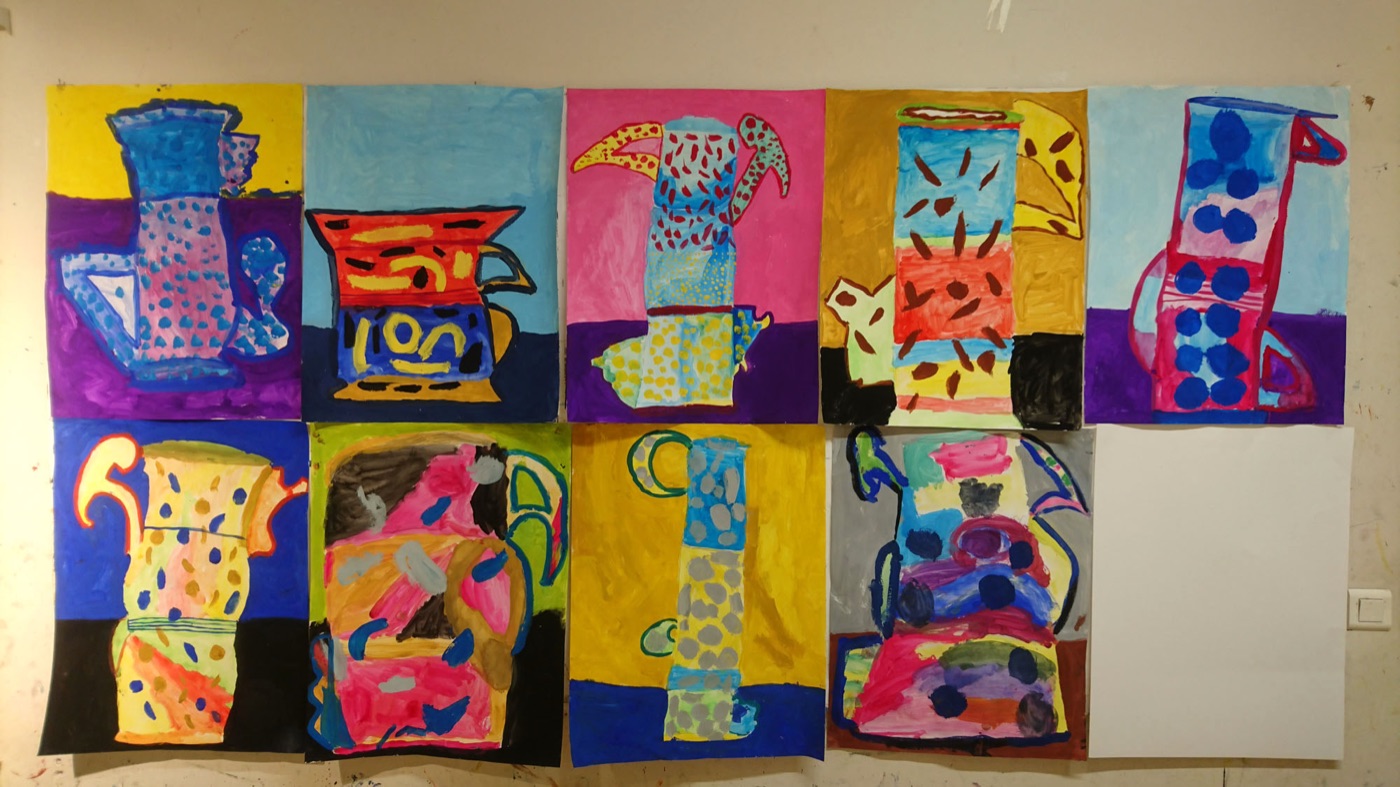
A set of gouache still lifes painted by pupils: jugs and vases in bright colours, in the spirit of Matisse.
Studio work — art stays on the timetable right to the end of middle school.
The three years

A short cycle, three clear challenges

Three years is not long. Each year has its own purpose, and nothing can be made up in the third.

Year 1

Settling in

Finding your feet.

New teachers, a new timetable, new expectations about presentation and rigour. We put the basics in place: keeping a diary, organising exercise books, asking a question when you have not understood.

This is the year we watch most closely, because a bad habit picked up here lasts three years.

Year 2

Going deeper

The heart of the cycle.

The programmes become markedly denser, in mathematics as in science. Languages call for structured expression, not just exercises. Pupils move from “learning by heart” to “understanding and reusing”.

The year that is least visible to parents — and often the most decisive.

Year 3

Finishing and choosing

Brevet and secondary school.

The year of the national lower-secondary certificate, and of choosing a secondary school. Organised revision, practice in the format of the papers, and guidance work carried out with the pupil and their family.

Continuous assessment this year counts towards the certificate: it is not decided in June.

The programme

Middle school subjects

The Moroccan national curriculum for the lower-secondary cycle, taught in Arabic and in French.

Arabic

Study of texts, grammar and rhetoric, argued written expression. Pupils learn to defend an idea in writing, not merely to reproduce a lesson.

French

Reading whole works and extracts, grammar, verb forms, written work. Speaking is still worked on: presentations, reading aloud, class debates.

English

Grammar, vocabulary, comprehension and expression. At middle school English becomes a working language: pupils read, write and speak in it, they do not just translate.

Mathematics

Algebra, equations, functions, geometry and theorems, statistics. Proof arrives: justifying becomes as important as finding the answer.

Life and earth sciences

The human body, nutrition, reproduction, geology, the environment. Observation, diagrams and experiment.

Physics and chemistry

Electricity, mechanics, optics, matter and chemical reactions. Practical work anchors the ideas in something real rather than in formulas.

History, geography and citizenship

The great historical periods, the geography of Morocco and of the world, institutions, rights and duties. Pupils also learn to read a map, a graph and a source document.

Islamic education

As set out in the official programme: texts, the principles of worship, and reflection on values and behaviour — work that is useful at precisely this age.

Physical education, art and computing

Sport, artistic activities and an introduction to computing round out the week. These are not minor subjects: they are often where a pupil who struggles elsewhere comes into their own.

Method

Learning how to learn

“He is bright but he does not work” is almost always a misdiagnosis. Most of the time, the pupil simply does not know how to go about it.

Nobody is born knowing how to plan revision across five days, how to take useful notes, or how to learn a lesson by some means other than reading it through three times. These things are taught, and they are taught in class, in every subject, not in a separate “study skills” course.

We check them where they show: in the exercise books, in the diary, in the way a test has been prepared for. A pupil who learns to organise themselves at middle school arrives at secondary school with an advantage that cannot be made up later.

In practice

What we work on with them

  • Keeping a diary — and using it to plan, not only to write things down.
  • Taking notes that are still legible and comprehensible three weeks later.
  • Learning actively: reciting to yourself, redoing the exercises, testing yourself — rather than rereading passively.
  • Reading a question right to the end and working out what is actually being asked.
  • Writing a full answer, with the justification — that is what earns the marks in the brevet.
  • Asking for help in time, which is a skill and not an admission of weakness.
End of the cycle

The brevet, then secondary school

Two separate milestones, prepared for in different ways.

The national lower-secondary certificate

The brevet is the certificate awarded at the end of middle school in Morocco. It does not rest on a single paper: it combines a regional examination, an examination set by the school itself and the continuous assessment mark.

That structure has a practical consequence which many pupils discover too late: the work done throughout the third year genuinely counts towards the final result. There is no “making it up at the last minute”.

Our preparation follows that logic — regular practice in the format of the papers spread across the year, rather than a crash revision session in the spring.

Choosing a secondary school

After the third year, pupils go on to secondary school, first in the common core year and then in the stream they have chosen — sciences, humanities, or a technical route depending on the school.

That choice is prepared during the third year, with your child and with you. We talk about what they enjoy, what they do well — the two do not always coincide — and what each stream really demands.

We provide the documents needed for their application and we are happy to answer questions from secondary schools that want to know more about their record.

Worth knowing

Les Écoles Melrose stops at middle school

We have no secondary school. The journey here runs from preschool to the third year of middle school: at the end of that year, your child moves on to a state or private secondary school to continue their education.

We would rather tell you this plainly now than at the point of enrolling in the third year. Our role is to make sure your child arrives at secondary school with a good record, solid foundations and the habit of working independently.

Support

Supporting teenagers, not only pupils

Between twelve and fifteen, school results are only one symptom among several.

Seeing the signals

A sudden drop in averages, a pupil withdrawing, no longer handing in work or changing their attitude: in a school on a human scale, that does not go unnoticed. And you are told.

Clear rules

Punctuality, dress, respect for adults and for classmates, phone use: the rules are set out, known to the pupils, and applied in the same way to everyone. It is what teenagers ask for, even when they protest.

Giving them responsibility

Class projects, artistic and sporting activities, community initiatives: teenagers commit when they are trusted with something real. It is also how they get their confidence back when the marks are going badly.

Day-to-day school life

Frequently asked questions

What parents ask us

What exactly is the brevet?

The brevet is the national lower-secondary certificate awarded at the end of the three years of middle school in Morocco. It does not rest on a single paper: it combines a regional examination, an examination set by the school itself and the continuous assessment mark.

In practice, that means the work done throughout the third year genuinely counts towards the final result — and that preparation starts in September, not in May.

Is the move from primary to middle school difficult?

It is a real change: several teachers instead of one, a timetable to manage, tests to plan for several days ahead. The difficulty is rarely the level of the lessons — it is the organisation.

Our pupils coming from the school's own primary stay in the same buildings and find adults they already know, which takes away much of the shock. Pupils who join us from elsewhere are followed closely through the first term.

My child gets good results but does not work independently. What do you do?

That is the profile that most often comes unstuck in the third year, when the workload increases and memory alone is no longer enough.

We teach method explicitly: keeping the diary, planning revision, taking notes, learning a lesson actively. This is not theory — it is corrected in the exercise books and checked in the results of the tests that follow.

What happens after the third year, since the school has no secondary school?

That is correct: Les Écoles Melrose stops at middle school. At the end of the third year, your child moves on to a state or private secondary school for the common core year and then the stream they choose.

We help them with that choice during the third year and we provide the documents needed for their application. Our aim is that they arrive at secondary school with solid foundations and the habit of working independently.

How do you handle adolescence — motivation, behaviour, phones?

With clear rules, applied in the same way to everyone, and frank dialogue with families. A sudden drop in results, a pupil withdrawing or a change in attitude are reported to parents quickly, because at this age those signals matter as much as marks.

The code of conduct, given to you when you enrol, sets out what is expected of pupils, including the use of mobile phones on the school site.

A question that is not here? Write to us or call 05 23 37 16 14.

Enrol your child in the middle school

Tell us the year you are after and the school your child is coming from: we will call you back to arrange a visit, an interview and the paperwork.