Preschool

Three preschool years, from the age of three. These are the years when a child learns to speak, to listen, to hold a pencil and to live alongside twenty other children — and when they decide, often for a long time to come, whether school is a pleasant place to be.

What we do here

This is not a crèche — it is the ground floor of the house

Much of what plays out in primary school is prepared here. A child who arrives in Year 1 with vocabulary, a hand that knows how to hold a pencil, the habit of staying attentive for a few minutes and the wish to do things well does not start from the same place as a child discovering all of that at the same time as reading.

Preschool is now a full part of the Moroccan school journey, and we treat it as such: clear goals for each year, teachers who observe and record progress, and real progression from one year to the next.

But it is still preschool. Children learn by playing, by handling things, by singing and by getting things wrong without consequence. At this age, boredom and constraint teach nothing.

  • Days with a clear, predictable rhythm. Landmarks reassure: a child who knows what comes next is a child who is free to learn.
  • Groups on a human scale. A teacher cannot get every child talking every day if the class is too large.
  • Continuity through to middle school. Your child grows up in the same school — they know the place, the adults and the rules.
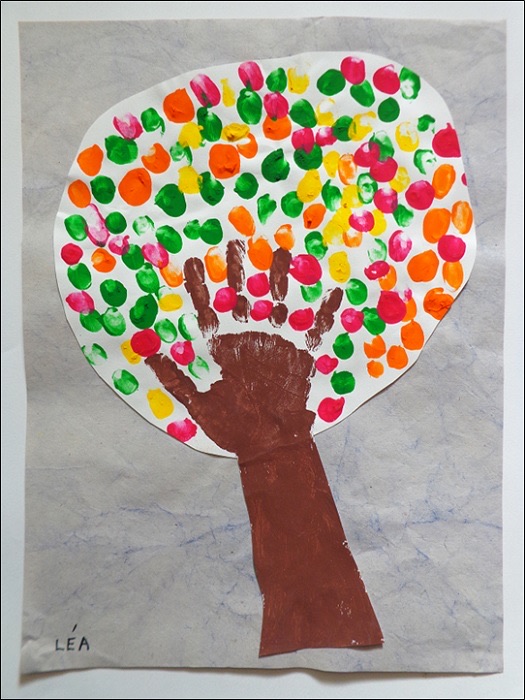
Tree painted by a preschool child: the trunk is a print of her hand and the leaves are coloured fingerprints.
The seasons tree — hand prints and fingerprints, made in class.
The three preschool years

Three years, three different goals

You do not ask the same things of a three-year-old and of a five-year-old. Each year has its own demands.

Around 3 years old

First preschool year

Coming into school.

The year of separating from home, of the first collective “good morning”, of the first independent gestures. Children learn to line up, to listen to a story right through, to name what they see, to work with modelling clay, thick brushes and large beads.
Around 4 years old

Second preschool year

Enriching and refining.

Language takes off: longer sentences, more precise vocabulary, the ability to tell a story. The hand comes under control — children draw, cut and glue. They start to count for real, to compare, to sort, and to recognise their own name.

Around 5 years old

Third preschool year

Getting ready for Year 1.

The pivotal year. Children work on the sounds inside words, on writing letters, on first quantities and on sustained attention. By the end of the year, a child should be able to stay focused on a task, understand a two-step instruction and hold a pencil correctly.

Which year your child joins depends on their age at the start of the school year. Give us their date of birth and we will answer straight away.

The rhythm

A day in preschool

The day always alternates between quiet times and active times, between whole-class times and small-group times. A three-year-old cannot sit through an hour of the same activity, and we do not ask them to.

The outline alongside is that of an ordinary day. Exact times, school days and the organisation of outings are given to you when you enrol and displayed at the school entrance.

  1. Arrival

    Children say goodbye to their parents, put away their bag and coat by themselves, and find their friends again. The morning ritual is always the same — that is what makes it reassuring.

  2. Circle time

    Everyone sits together: the date, the weather, who is here and who is away, the song of the day, what we are going to do today. This is the moment when children learn to speak in front of others and to listen when it is not their turn.

  3. Workshops

    The class splits into small groups that rotate: language with the teacher, pre-writing patterns, handling numbers, guided free play. This is where most of the learning happens.

  4. Playtime and movement

    Running, climbing, throwing, dancing. Physical activity is not a break from learning: it is learning — learning the body and space.

  5. Stories, singing, art

    The afternoon gives more room to picture books read aloud, to rhymes in Arabic and in French, and to painting and collage.

  6. Settling back down

    Children tidy up together, go back over what they have learned and collect the day's work. They leave with something to tell you about at home.

Learning

What your child works on, in concrete terms

Six areas, worked on every day in different forms.

Language

Understanding, making yourself understood, building vocabulary, telling a story. It is the number one area in preschool: everything else depends on it. Arabic gives the class its structure, and French settles in through rhymes, picture books and daily rituals.

First numbers

Counting for real — not reciting. Counting out a set of objects, comparing “more” and “fewer”, recognising numerals, sorting, ordering, copying a pattern. Shapes and sizes come along with it.

Movement and coordination

Gross motor skills — running, jumping, balancing — and fine ones: cutting, threading, screwing, drawing. The hand that will write in Year 1 is prepared here, with modelling clay and scissors.

Living in a group

Waiting your turn, lending things, saying “I don't agree” with words rather than with your hands, helping a classmate. This kind of learning takes time and is worked on every day, situation by situation.

Creative work

Painting, gluing, modelling, singing, dancing, playing a small part. At Les Écoles Melrose, the arts are not a Friday-afternoon reward: they are a way of learning, and the walls of the school show it.

Discovering the world

The seasons, animals, the body, water, the plants they grow in class. Children observe, describe and ask questions — the first scientific habits begin here.

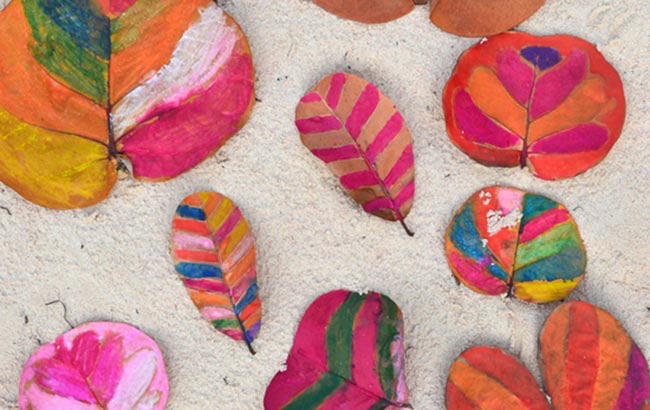
Autumn leaves painted by the children, arranged in a circle on sand — a project combining art and learning about the seasons.
The seasons, in paint: art and discovering the world, in one and the same activity.
What comes next

Moving into Year 1, without a break

Starting primary school is a real change: you sit still for longer, you write properly, your school bag is heavy. Many children experience it as a rupture because they change school, building and adults all at the same time.

Here, that is not the case. Your child stays in the same buildings, sees the same faces at playtime, and their preschool teacher can speak directly to the Year 1 teacher about what they can do and what is still fragile.

Discover the primary school

By the end of the third preschool year

What we aim for with every child

  • Speaking in complete sentences and recounting a simple event
  • Hearing the sounds inside words and recognising letters
  • Holding a pencil correctly and writing their own first name
  • Counting small quantities and comparing them
  • Understanding a two-step instruction and seeing it through
  • Managing alone: clothes, belongings, the toilet, tidying up

No child ticks every box at the same time, and that is fine. What matters is that you know where yours has got to — and you will.

Practical

Getting your child ready for the start of the year

What you prepare on your side, and what you can expect from ours.

What you provide

  • A small bag your child can open and close on their own
  • Comfortable clothes that can get paint on them
  • Shoes your child can put on alone (Velcro rather than laces)
  • A complete change of clothes, labelled with their name
  • A water bottle

The full list of required equipment, along with information about school clothing, is given to you when you enrol.

What you can expect from us

  • That we tell you how the day went, especially in the first few weeks
  • That we flag a difficulty when it appears, not at the end of the year
  • That we see you when you ask, without waiting for the parents' meeting
  • That we call you immediately in case of a fall, a fever or an incident
  • That your child is called by their first name, by every adult in the school

Day-to-day life at school

For practical questions — lunches, transport, after-school care, fees — give us a call: we would rather answer you precisely than announce arrangements here that change from one year to the next.

Frequently asked questions

What parents ask us

How old does my child have to be to start the first preschool year?

Preschool takes children from around the age of three, in the first preschool year. As everywhere, admission depends on your child's date of birth in relation to the start of the school year: call us with the exact date and we will tell you straight away which year they would join.

My child has never been looked after outside the home. How does settling in work?

The first few weeks are designed for exactly that. We set up simple, unchanging landmarks, we name what is about to happen before it happens, and the teacher keeps you informed about how your child is getting through the day.

Tears in the morning are common in the first few days and almost always stop quickly — often before you have even reached the end of the street. If that is not the case, we talk it over with you and adapt.

Does my child need to be out of nappies before starting preschool?

That is what is generally expected at the start of the first preschool year, and above all it is more comfortable for the child. That said, accidents remain normal at this age and are never made into a drama — which is why we ask for a change of clothes in the bag.

If your child is not there yet, tell us honestly when you enrol rather than after the term has started.

Is French taught from the first preschool year?

Yes, French is there from preschool onwards — but in the way preschool does things: through rhymes, picture books read aloud, games and the rituals of the day, not through grammar lessons.

The aim at this age is for the ear to grow used to the language and for the child to dare to repeat, not to produce perfect sentences. English comes later in their schooling.

How will I know whether my child is making progress, when there are no marks?

In preschool we observe rather than mark. The teacher follows very concrete things: vocabulary, sentence length, independence, how a pencil is held, the ability to concentrate, the way they play with others.

These observations are shared with you at meetings with the teacher and in the progress documents handed out during the year. And if something worries us, we tell you without waiting.

A question that is not here? Write to us or call 05 23 37 16 14.

Come and see the classroom before you decide

A ten-minute visit will tell you more than a web page. We welcome families all year round, with or without an appointment.