A private school in El Jadida, from preschool to middle school, where the work is taken
seriously without anyone forgetting that we are dealing with children.
Who we are
A neighbourhood school, built to take children all the way through middle school
Les Écoles Melrose is a private school in Hay El Matar, opposite Marjane, in El Jadida.
We welcome children from preschool onwards, then right through primary and middle school
— three stages, one school, one team.
Our path stops at the end of Year 3 of middle school: we have no secondary school. That
is a deliberate choice. It lets us concentrate our resources on the years that build
everything else — the years in which a child learns to read, to reason, to work alone
and to keep an exercise book tidy.
The school has grown up with the families of the neighbourhood, and it is to them that
we answer. Our ambition fits into a single sentence: that a parent who entrusts us with
their child can recommend us to their neighbour without hesitating.
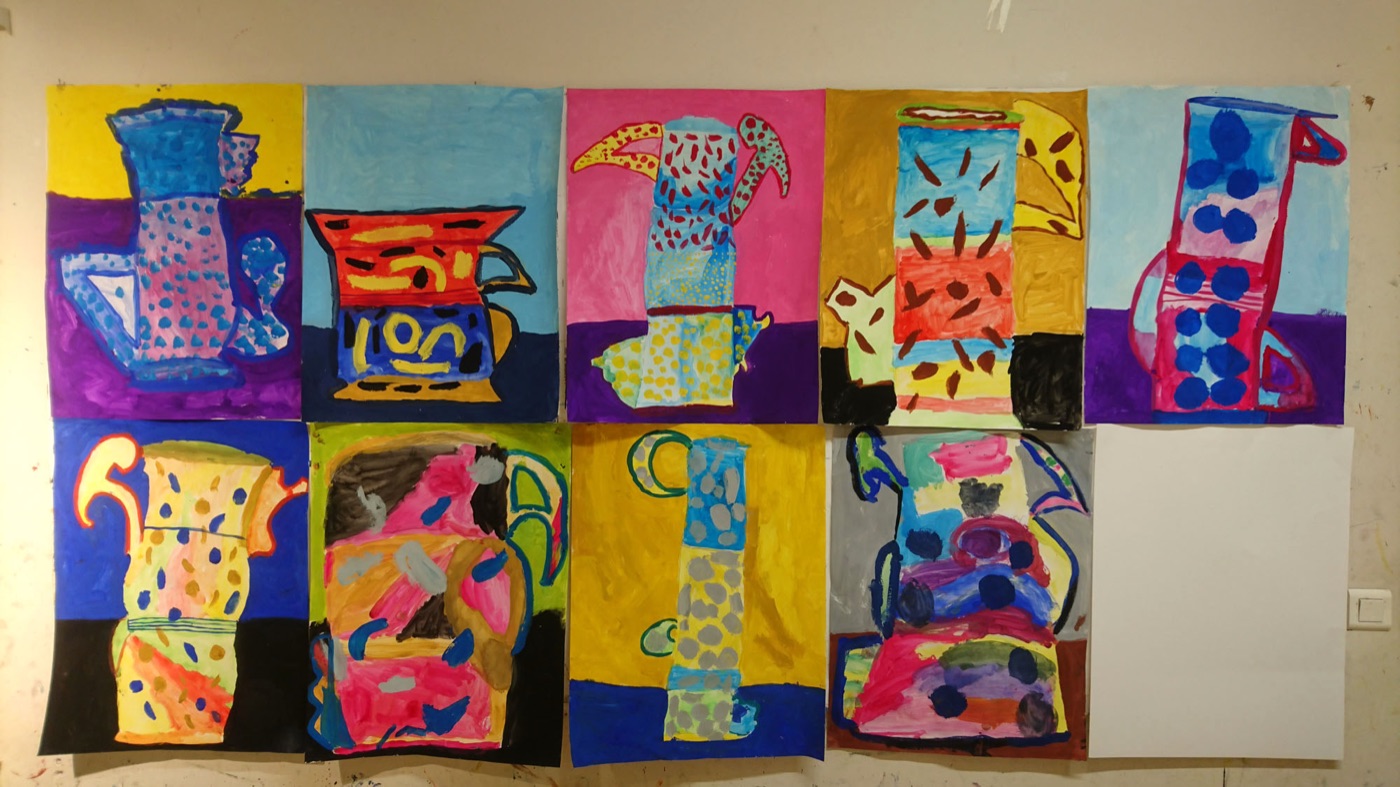
Pupils' work made in the art studio, at the school.
Our approach
Four convictions, and what they change day to day
Plenty of schools advertise the same values. Here, concretely, is what ours mean for your
child, week after week.
Academic excellence
We follow the Moroccan national curriculum, and we do not skim over it. The aim is not
to move faster than everyone else: it is that nothing is left vague. An idea half
understood in Year 3 becomes a blockage in Year 6.
The work is steady rather than intensive: short revision, frequent assessment, and
immediate reteaching as soon as a pupil comes unstuck on a particular point.
The Moroccan national curriculum, followed rigorously
Regular assessments, marked and explained in class
Extra help as soon as a difficulty appears, not at the end of the year
Personal growth
A child who is afraid of getting it wrong does not learn. We insist on a climate where
putting your hand up carries no risk, where a mistake is part of the work, and where we
correct the exercise, never the pupil.
That means knowing the children: their character, what puts them at ease, what stops
them. It is easier in a school on a human scale — which is exactly why we mean to stay
one.
Clear boundaries, explained to the children rather than imposed on them
Attention paid to the quiet children, not only to the loudest
Zero tolerance for mockery and bullying
Creativity
Drawing, painting, music, dance and drama are not rewards to be cancelled when the
syllabus falls behind. They are part of the week, in the same way as mathematics.
A child who has painted a landscape, learnt a text by heart or built a set with their
class is also working on concentration, memory and confidence in front of an audience.
The school walls are covered with that work.
Art and fine art right through the year
Music, dance and drama
Pupils' work put on display, not filed away in a drawer
Citizenship
Respect is not taught in a chapter: it is settled in the playground, in the line, in the
way a child speaks to the cleaner and tidies their desk. That is where we are demanding.
Pupils take on real responsibilities within their class and the school, and take part in
shared projects that take them beyond strictly academic work.
Responsibilities entrusted to pupils in the life of the class
Older and younger pupils helping one another
Shared projects and activities within the community
Our programmes
Four areas in which we put pupils to work
Beyond the compulsory subjects, school life here is organised around four complementary
strands.
Academic
Science, languages and mathematics: the heart of the curriculum, worked at with method
and regularity.
Artistic
Music, dance, drama and fine art, taught and practised regularly.
Sporting
The body needs to move for the head to follow: physical activity, team games and team
spirit.
Leadership
Speaking up, organising, deciding as a group and standing by it: skills that are learnt
early.
Languages
Three languages, each introduced at its own moment
We teach Arabic, French and English. Piling three languages onto a four-year-old serves
no purpose: what counts is the order in which they arrive and the consistency with which
they are worked on afterwards.
In preschool, the priority is spoken language. In primary school, reading and writing are
put in place. In middle school, languages become working tools: pupils read texts, write
and argue a case.
Arabic gives Moroccan schooling its structure. It is worked on from preschool onwards
in speech, then in reading and writing right through primary school, and it serves as
the language of instruction for a significant share of subjects.
French
Introduced early, consolidated for years
French starts with rhymes, stories and everyday vocabulary in preschool, before
becoming a subject in its own right in primary and then middle school. In Morocco it is
often the language that decides the rest of a pupil's schooling — we give it the time
it needs.
English
Added step by step
English arrives later and builds up towards middle school, where it becomes a regular
subject. The goal by the end of Year 3 is not perfection, but a pupil who can
understand, read and make themselves understood.
Our team
Teachers who know your children — and who talk to you
The quality of a school rests first of all on the people standing in front of the class,
and on what they tell you about your child.
A lead teacher for the class
In preschool and primary school, each class has its main teacher: the same person all
year, the one who notices when a child is tired, bored or slipping. In middle school,
pupils move to a teacher per subject, supported by one teacher who follows the class.
Direct contact with parents
We would rather call you before a problem turns into a disappointing report. You can
reach the school by phone or on WhatsApp, ask for an appointment with your child's
teacher, and come in and talk it through calmly.
Written feedback, regularly
Beyond the marks, you receive information about behaviour, participation and your child's
real progress. We tell you what is going well, and what needs going over again at home.
Are you a teacher?
We are always glad to meet teachers and educators who would like to join a small school
where the staff know their pupils.
The school is in Hay El Matar, opposite Marjane — easy to reach and easy for anyone in
El Jadida to find.
We could write a flattering list of facilities here. We would rather open the doors to
you: ten minutes on site will tell you more than three paragraphs about how clean the
building is, how big the playground is and what the atmosphere in the corridors feels
like.
If you have a specific question before making the trip — meals, transport, opening hours,
equipment available — call us or write to us on WhatsApp: we answer you ourselves.