Primary school

Six years, from Year 1 to Year 6. This is where everything else is built: reading fluently, writing correctly, calculating without hesitating, and getting into the habit of working.

Our approach

The fundamentals first — and nobody left behind

Primary school in Morocco lasts six years and follows the official programme of the Ministry of National Education. That is our foundation: we do not invent a parallel curriculum, we apply ourselves to teaching that one well.

What makes the difference is not the programme — it is the same everywhere — but the attention given to each pupil. A child who has not understood subtraction with carrying in Year 2 will drag that gap along for years if nobody notices. Our job is precisely to notice.

  • Three languages. Arabic and French give the schooling its structure, and English is added as the cycle goes on.
  • Class sizes kept down. So that a teacher can walk between the desks and see who has understood.
  • Art and sport every week. Not optional, not “when there is time”.
  • A middle school in the same establishment. Year 6 does not end with a move.
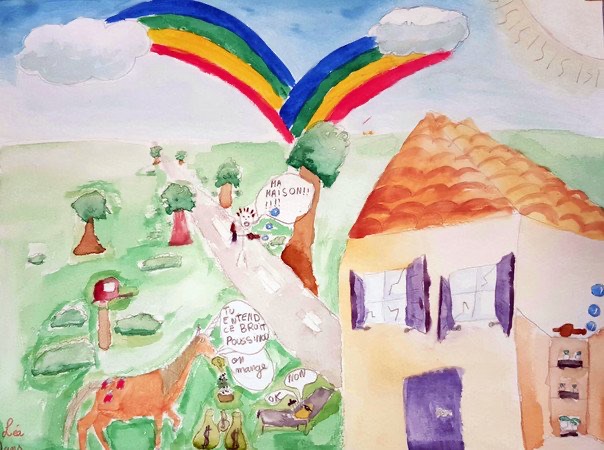
Watercolour landscape painted by a primary pupil: a house, a rainbow and a horse in a field.
A watercolour made in class — perspective, colour and composition.
The six years

What each stage builds

The cycle moves forward in stages. Each one has its own purpose — and its own risk, if it is missed.

Years 1 and 2

Learning to read and write

The decisive stage.

Decoding first, then reading that flows. Handwriting taking shape. Numbers, addition and subtraction. And one invisible but decisive thing: becoming a pupil — sitting down, listening to an instruction, keeping a tidy exercise book, handing in finished work.

This is when falling behind costs the most, so it is when we watch most closely.
Years 3 and 4

Understanding, not just reading

Consolidation.

Children move from “reading the words” to “understanding the text”. Grammar and verb forms become serious, in Arabic as well as in French. In mathematics: multiplication, division, first multi-step problems. Science and history and geography take their place.

It is also the age at which pupils learn to write out an answer, not just to give a result.

Years 5 and 6

Working as they will in middle school

Preparation.

Fractions, decimals, geometry, proportion. Longer texts and structured pieces of writing. Above all: method — keeping a diary, preparing for a test several days ahead, revising without being asked.

Year 6 ends with the end-of-primary examination, which opens the way to middle school.

The programme

Primary school subjects

The official Moroccan national curriculum, taught in Arabic and in French, with English added during the cycle.

Arabic

Reading, written and spoken expression, grammar, verb forms, spelling and recitation. It is the main language of instruction and the backbone of the cycle.

French

Present from the start of the cycle. Reading, vocabulary, grammar, verb forms and writing — with a great deal of speaking, because a language you do not speak never really takes hold.

English

Introduced during the primary cycle, first through speaking, everyday vocabulary and songs, before moving on to writing.

Mathematics

Number and calculation, measurement, geometry, and above all problem solving — knowing which operation to choose matters as much as knowing how to set it out.

Science

The human body, animals and plants, water, air, matter, the environment. Pupils observe, experiment and record what they saw — the method matters as much as the answer.

Islamic education

As set out in the official programme: the Qur'an, the principles of faith and worship, and a large part devoted to values — honesty, respect for parents, helping one another, cleanliness.

History, geography and citizenship

Placing yourself in time and in space: Morocco, its history, its regions, the world. And citizenship education — rights, duties, life in a community.

Art

Drawing, painting, collage, music and drama. At Les Écoles Melrose it is a subject in its own right — everything displayed in the corridors comes out of those lessons.

Physical education

Team games, athletics, coordination, the rules of the game. Pupils also learn to lose, to play with others and to respect a referee.

Assessment

Knowing where your child stands, in real time

The worst situation for a parent is to discover in June a problem that has been there since November. We organise assessment so that this does not happen.

Assessment in primary school rests on continuous assessment: regular exercises and pieces of homework in every subject, marked and handed back, which feed into the averages and the end-of-term reports.

But marks do not tell the whole story. A teacher who knows their pupils can also read what is not marked: the pupil who never asks a question, the one who copies without understanding, the one who has understood but hands in careless work. Those are the observations we pass on to you at our meetings.

What you receive, and when

  • Marked homework and tests, handed back to your child — look at them, they say far more than an average.
  • An end-of-term report, with results by subject and the teacher's comments.
  • Parent-teacher meetings, where we talk about your child in particular and not about the class in general.
  • A call or a note as soon as there is a problem — with attainment, with behaviour, or simply with morale.

And in the other direction: if something worries you, you do not have to wait for the next meeting to ask for an appointment.

Get in touch with the school

Homework and support

When a pupil is struggling

No child moves forward in a straight line. What counts is what is done when they stumble.

1. Spot it early

A pupil almost never falls behind overnight. The signs show up in exercise books, in participation, in how long it takes to get started on a task. The teacher sees them and reports them.

2. Teach it differently

We do not re-explain the same thing in the same way: the idea is taken up again in a small group, starting from something concrete, with exercises matched to where the block really is rather than to the current chapter.

3. Bring the family in

We tell you exactly what to do — and what not to do. Ten minutes of reading aloud each evening is worth more than an hour of fraught homework.

Homework

What it should be — and what it should not be

Homework is there to fix what has been understood in class. It increases gradually from one year to the next: a few minutes of reading in Year 1, a proper organised working session in Year 6.

It should not be used to teach, in your place, what the school did not have time to cover, nor to turn your evenings into a battlefield.

Three pointers for parents

  • A fixed place and a fixed time are worth more than a long stretch.
  • Having the instructions read aloud before starting solves half the blockages.
  • If a piece of homework takes far longer than expected, stop and write a note to the teacher. That is useful information, not an admission of failure.
What comes next

From Year 6 to middle school

Year 6 ends with the standardised end-of-primary examination, which leads to the primary school certificate and opens the way to middle school. We prepare pupils for it throughout the year — without making it the only horizon of those twelve months.

The real change is not the examination, it is middle school itself: one teacher per subject instead of a single class teacher, a timetable to manage, tests to plan for. That is why Years 5 and 6 insist as much on how to work as on what to learn.

Our pupils go on to middle school in the same establishment, with the same landmarks and a team that already knows them.

Discover the middle school

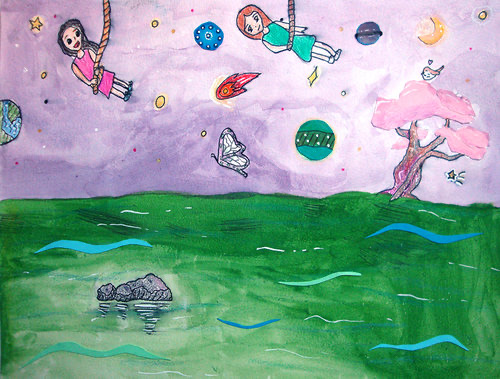
Pupil's watercolour: two children on swings in a green field, under a violet sky.
A watercolour made in class — the playground as seen by a primary pupil.
Frequently asked questions

What parents ask us

How will I be told what my child's real level is?

Through three channels: continuous assessment, whose results reach you regularly; the end-of-term reports; and meetings with the teacher.

Above all, we want nothing to surprise you at the end of the year. If your child falls behind in October, you hear about it in October — not in June.

How much homework will my child have each evening?

The quantity increases gradually from one year to the next. The principle we follow is simple: homework is there to consolidate what has already been understood in class, not to do the school's teaching for it.

If your child spends far longer on it than their classmates, that is a signal. Tell the teacher rather than making up for it alone at home.

What do you do if my child falls behind in reading or mathematics?

First identify precisely where the block is — it is not “he is bad at maths”, it is “he has not mastered carrying” or “he cannot choose the right operation”. Then deal with it: going over it again in a small group or one to one, adapted exercises, and regular updates with you.

We tell you as soon as the difficulty is spotted, and we explain what you can do at home without turning your evenings into a second school.

My child is coming from another school — can they join partway through the cycle?

Yes, provided there is a place available in the year requested. Depending on the year, we arrange an interview and, in most cases, a placement test — not to sort pupils, but to know where we are starting from, particularly in languages.

If some catching up is needed, it is better to know in September than in January.

Is there an examination at the end of primary school?

Yes. At the end of Year 6, pupils in Morocco sit the standardised end-of-primary examination, which leads to the primary school certificate and opens the way to middle school.

We prepare pupils for it throughout the year, with regular practice in the format of the paper — without making it the only horizon of Year 6.

A question that is not here? Write to us or call 05 23 37 16 14.

Enrol your child in the primary school

Tell us your child's age and the year you are after: we will call you back to arrange a visit and give you the list of documents to provide.