Our levels

Preschool, primary and middle school: three stages, one school, one team that follows your child from the age of 3 to the start of secondary school.

A continuous path

Twelve years without changing school

Here, the move from the last preschool year into Year 1, and then from Year 6 into middle school, does not happen in a new building, with new classmates and adults who are discovering your child for the first time. It happens within the same walls.

In practice, that means the Year 1 teacher already knows how the child was working in the final preschool year, and that the middle-school team knows the pupils arriving from primary. Difficulties are handed on, and so are strengths.

Our path stops at Year 3 of middle school: we have no secondary school. Our work over those three years is therefore to prepare your child to start secondary school with a standard and with working habits that hold up.

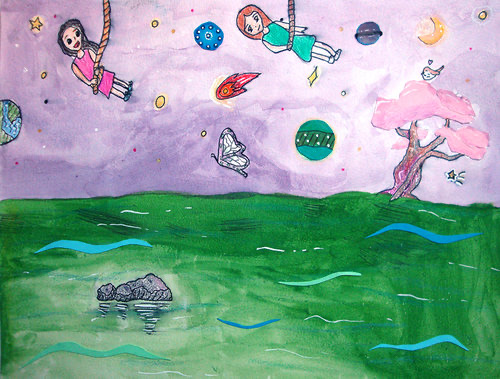
A pupil's watercolour: children on swings in a green field under a purple sky.
A watercolour painted by a pupil at the school.
The three levels

What each stage covers

For each level: the ages concerned, what is worked on and what you can reasonably expect from it.

From age 3

Preschool

The three preschool years — three years before Year 1.

This is your child's first school, and often their first separation from you. Our priority is not to have them reading words as early as possible: it is that they come in each morning without crying, that they dare to speak in front of the others and that they learn to manage on their own.

Everything happens through play, handling things and repetition: songs, stories, cutting out, modelling clay, sorting games. School work comes afterwards, in the final preschool year, once the hand and the attention span are ready.

Discover our preschool

On the programme

  • Spoken language: vocabulary, stories, nursery rhymes
  • A first taste of French, alongside Arabic
  • Mark-making and preparation for writing
  • Numbers, shapes, sorting and a sense of time
  • Motor skills, art, singing and group play

What you will see at home

A child who tells you about their day, who sings songs you have never heard, who brings drawings home — and who wants to do on their own what you were still doing for them six months ago.

Years 1 to 6

Primary school

Six years, generally from age 6 to 11 or 12.

Primary school settles a great deal. A pupil who leaves Year 6 reading fluently, writing correctly and confident with arithmetic starts middle school without fear. Otherwise, they will spend three years catching up.

We follow the Moroccan national curriculum and we give ourselves the means to leave nobody by the wayside: frequent assessment, going back over anything that was not properly grasped, and a word to parents as soon as something starts to stick.

Discover our primary school

On the programme

  • Reading, writing and expression
  • Mathematics: arithmetic, geometry, problem solving
  • Arabic, French and English
  • Introductory science, history and geography, Islamic education
  • Art, music and sport every week

What you will see at home

Homework to do, a school bag to pack, lessons to recite. It is also the age at which your presence counts most: ten minutes of checking each evening is worth more than a long catch-up in June.

Years 1 to 3

Middle school

Three years, generally from age 12 to 15, up to the brevet.

In middle school, the way a pupil works changes: a teacher for each subject, several exercise books, tests coming one after another and a timetable to manage. Plenty of pupils who were solid in primary stumble here — not for want of ability, but for want of method.

So that is what we work on first, alongside the subjects themselves: organising your work, taking notes, revising in advance rather than the night before. The stage ends with the brevet, the national lower-secondary certificate, and with the choice of a path into secondary school.

Discover our middle school

On the programme

  • Mathematics and science in greater depth
  • Arabic, French and English, strengthened
  • Humanities and Islamic education
  • Study skills: organisation, note-taking, revision
  • Preparation for the brevet and for starting secondary school

What you will see at home

A more independent teenager, who still needs a framework: a place and a time to work, and an adult who looks at the school diary. We stay in touch with you, especially when things are not going well.

Compare

What changes from one level to the next

Same school, same team — but expectations and ways of working that change as the pupils grow up.

Ages 3 to 5

Preschool

The rhythm

Short blocks of time, alternating between activities, free play and quiet moments.

Languages

Arabic in speech, first exposure to French.

Follow-up

Day-to-day observation and frequent conversations with parents, rather than marks.

What we expect of the pupil

To come in happily, to listen, to have a go, and to begin doing things alone.

Ages 6 to 11

Primary school

The rhythm

Days structured subject by subject, with homework and lessons to learn at home.

Languages

Arabic and French in reading and writing, then English.

Follow-up

Regular assessments, marks and reports sent to families.

What we expect of the pupil

Steady work, a well-kept exercise book and the reflex to ask when something is unclear.

Ages 12 to 15

Middle school

The rhythm

A teacher for each subject, a timetable, and tests to plan ahead for.

Languages

All three languages as working tools: reading, writing, arguing a case.

Follow-up

Continuous assessment, subject-by-subject reports and support in choosing what comes next.

What we expect of the pupil

Independence in organising themselves, and consistency all the way to the brevet.

A rough guide

Which level is right for my child?

In the Moroccan system the general rule is simple: children start Year 1 of primary school at 6, and the following years follow on from there. Preschool, for its part, takes children from the age of 3.

These are guides, not hard cut-offs. The exact age of admission depends on your child's date of birth and, if they are coming from another school, on the level they have actually reached. Tell us their age and their last class: we will give you a precise answer.

  1. Your child is 3, 4 or 5

    Preschool it is: the first preschool year at 3, the second at 4, the third at 5. See our preschool.

  2. They are 6

    That is the start of Year 1 of primary school, whether they did their preschool years with us or elsewhere. See our primary school.

  3. They are between 7 and 11

    They join primary school, from Year 2 to Year 6. If they are arriving from another school, we take stock of where they are before confirming the class.

  4. They are 12 or older

    They start middle school, from Year 1 to Year 3, through to the brevet. See our middle school.

  5. They have finished Year 3 of middle school

    Our path stops there: we have no secondary school. We support every pupil in choosing where to go next.

Is your child coming from another school?

It happens often, and it goes well provided the move is prepared. Depending on the level you have in mind, we arrange either an interview or a placement test: the aim is not to sort children, but to put your child in the class where they will genuinely be able to keep up.

If gaps appear — often in languages — we say so plainly and we tell you what will need going over.

Not sure which level? Let's talk.

Give us your child's age and their last class: we will tell you which level fits and what the enrolment file contains.